You might expect kelp or driftwood on a Southern California beach, but powerful ocean shifts can deliver a venomous yellow-bellied sea snake to your feet. These tropical pelagic reptiles normally hunt far south along warm tropical coastlines.
When a massive El Niño warms the eastern Pacific, shifting currents sweep these pelagic hunters hundreds of miles north. Cooling coastal waters then trap them in a state of paralyzing thermal shock.
Understanding this rare collision between tropical biology and ocean physics helps you spot these elusive creatures safely. It also clarifies why scientists track every single stranding along the coast.
In This Briefing07 Sections ▾
- 01The 2026 Stranding and California’s Historical Record
- 02The Oceanic Conveyor: How El Niño Alters the Coastline
- 03Thermal Shock: Why Tropical Serpents Strand on Sand
- 04Potent Venom and Beach Safety Realities
- 05Everyday Impact: How to Safely Search and Report
- 06Frequently Asked Questions
- 07Curiosity Close: Expanding Coastal Awareness
The 2026 Stranding and California’s Historical Record
On November 22, 2026, a beachcomber spotted an adult male yellow-bellied sea snake writhing on the sand at Bolsa Chica State Beach. The rare discovery instantly put coastal researchers and state authorities on high alert.
Officials from California State Parks confirmed the occurrence three days later. The cold-shocked snake died shortly after its discovery, and scientists transferred the specimen to the San Diego Natural History Museum for preservation.
This find marked only the eighth documented yellow-bellied sea snake in California since 1972. Intriguingly, seven of those eight confirmed arrivals took place during major El Niño events.
The historical record began on Thanksgiving morning in 1972 at San Clemente State Beach. Decades later, the powerful 2015–2016 ocean cycle brought three documented specimens across Ventura, Orange, and San Diego counties.
Two additional snakes appeared in Orange County in 2018, followed by the Bolsa Chica discovery in late 2026. Only one documented record—found in January 2018 at Newport Beach—occurred outside an active El Niño cycle.
A viral video surfaced in September 2026 showing an alleged sea snake at Crystal Cove State Beach. However, curators confirmed the footage lacked verifiable metadata, leaving that specific incident officially unconfirmed.
Every verified California stranding has occurred in a distinct seasonal window between October 4 and January 14. This timing reveals a repeatable pattern where seasonal ocean currents interact directly with global atmospheric shifts.
The Oceanic Conveyor: How El Niño Alters the Coastline
Yellow-bellied sea snakes, known scientifically as Hydrophis platurus, normally reach their northern eastern Pacific limit near southern Baja California. They depend entirely on open water, drifting along oceanic temperature contours where prey congregates.
An intensifying El Niño disrupts those normal limits. According to diagnostics from the NOAA Climate Prediction Center, sea surface temperatures in the equatorial Pacific surged to historic anomalies in late 2026.
NOAA registered temperature anomalies of plus 2.5 degrees Celsius in the central Pacific, maintaining an active advisory through early 2027. Subsurface eastern Pacific waters reached even higher departures from historical norms.
These shifts energize the Davidson Current, a seasonal coastal countercurrent that flows northward from October through February. As warm equatorial water pushes northward along North America, it creates a temporary aquatic highway for pelagic creatures.
A persistent coastal marine heatwave, tracked by oceanographers since May 2025, further warmed California’s nearshore zones. This regional warm anomaly allowed the cold-blooded reptiles to survive hundreds of miles beyond their typical geographical boundaries.
The snakes do not intentionally migrate toward California. Instead, they drift passively along oceanic current boundaries, feeding on surface fish while moving steadily poleward inside the warm water plume.
Thermal Shock: Why Tropical Serpents Strand on Sand
While warm offshore currents carry the reptiles northward, nearshore conditions present a deadly obstacle. Yellow-bellied sea snakes thrive best in water temperatures between 28 and 32 degrees Celsius.
Their bodies require warmth to sustain basic metabolic processes like digestion and navigation. When ambient water temperatures dip below 23 degrees Celsius, these snakes stop feeding and become increasingly sluggish.
Late November water temperatures along Southern California beaches typically hover between 55 and 64 degrees Fahrenheit. These chilly temperatures rapidly induce profound hypothermia and muscular paralysis in tropical reptiles.
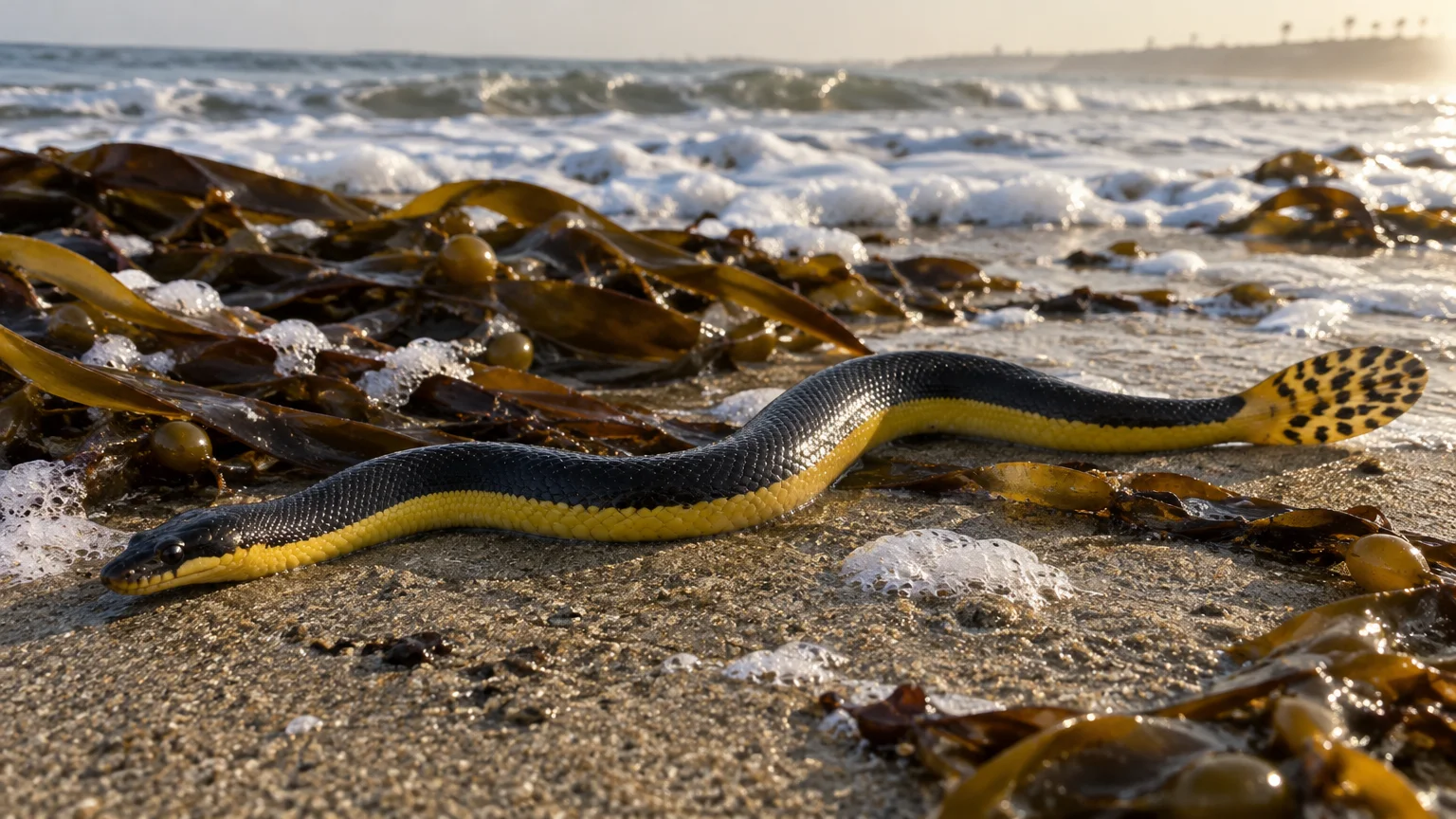
Unlike land snakes, this species is entirely pelagic and possesses a paddle-shaped tail for open-ocean swimming. They lack wide ventral scales, meaning they cannot grip the ground or crawl effectively once cast ashore.
When winter storms and powerful king tides churn nearshore waters, paralyzed snakes lose their ability to fight breaking waves. Surf sweeps them helplessly onto the wet sand, where they usually perish within 24 hours.
Potent Venom and Beach Safety Realities
Encountering a stranded sea snake demands extreme caution. As members of the elapid family, yellow-bellied sea snakes possess potent neurotoxic venom that paralyzes prey by targeting the nervous system.
Their venom carries a subcutaneous lethal dose measurement of 0.067 milligrams per kilogram. Even a small fraction of a milligram can induce muscle breakdown, severe pain, and respiratory failure in untreated victims.
Despite this terrifying biochemistry, these animals present minimal danger to beachgoers who maintain a respectful distance. California and Australia have recorded zero human fatalities from this species throughout modern history.
These sea snakes possess small mouths, short fangs, and a remarkably docile temperament. Most global bites occur when commercial fishers attempt to untangle live snakes from ocean fishing nets by hand.
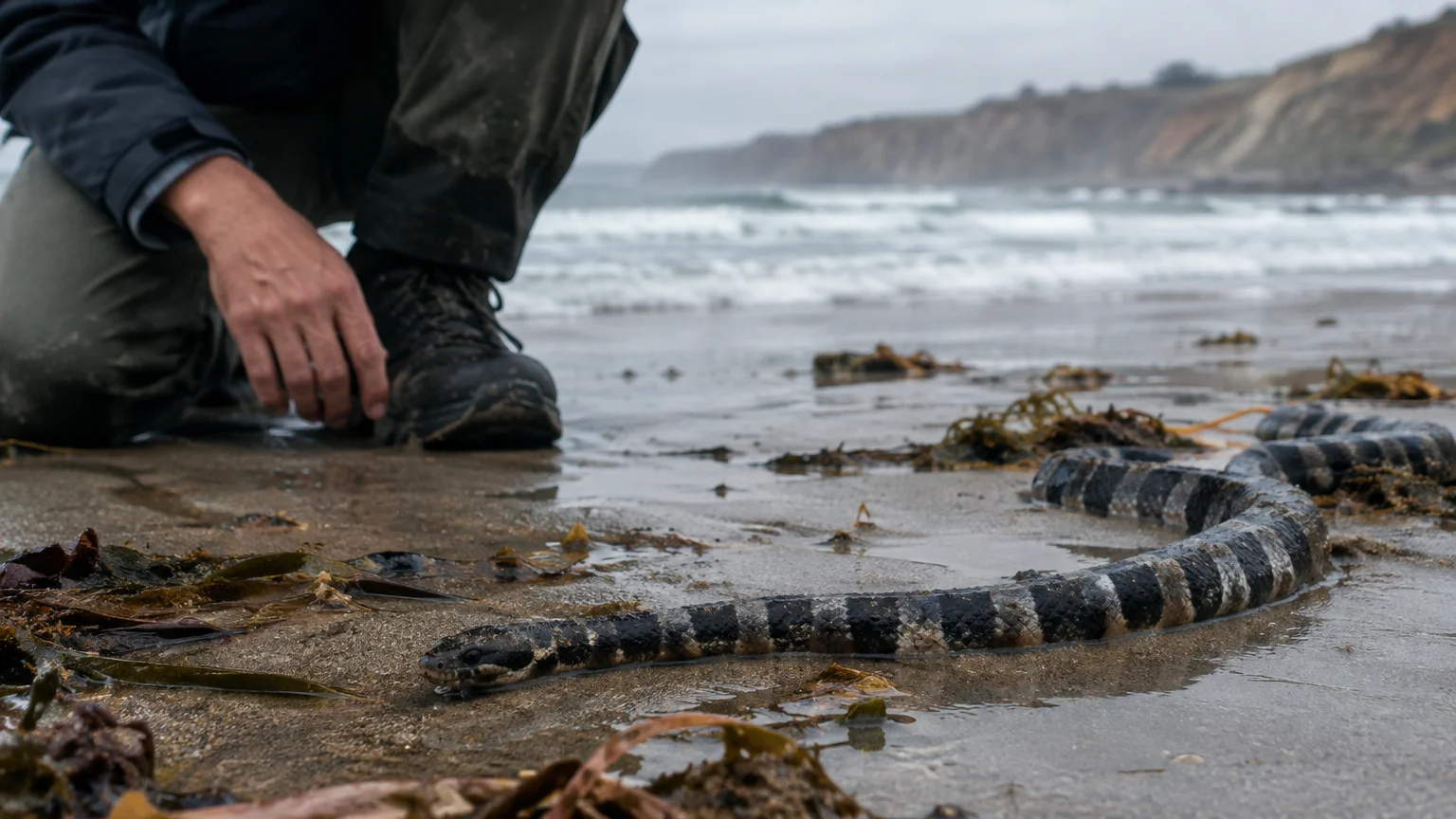
State park rangers and museum herpetologists urge you never to handle a stranded snake. You must also never attempt to shove a stranded animal back into crashing waves.
Pushing a cold-shocked snake into chilly surf only hastens exhaustion and death. The hypothermic reptile cannot swim against crashing waves and will simply wash back ashore down the beach.
Everyday Impact: How to Safely Search and Report
If you visit coastal beaches between November and February, you can contribute directly to ongoing marine science. The Natural History Museum of Los Angeles County monitors winter stranding reports through community observations.
Biologists identify king-tide cycles as the most productive windows for spotting stranded marine organisms. High tides dislodge drifting debris and wash open-ocean wildlife directly onto the high-tide wrack line.
Plan your beach walk roughly 90 minutes after peak high tide when the receding water reveals freshly deposited ocean drift. Walk slowly and inspect tangled kelp patties, where stranded creatures frequently seek refuge.
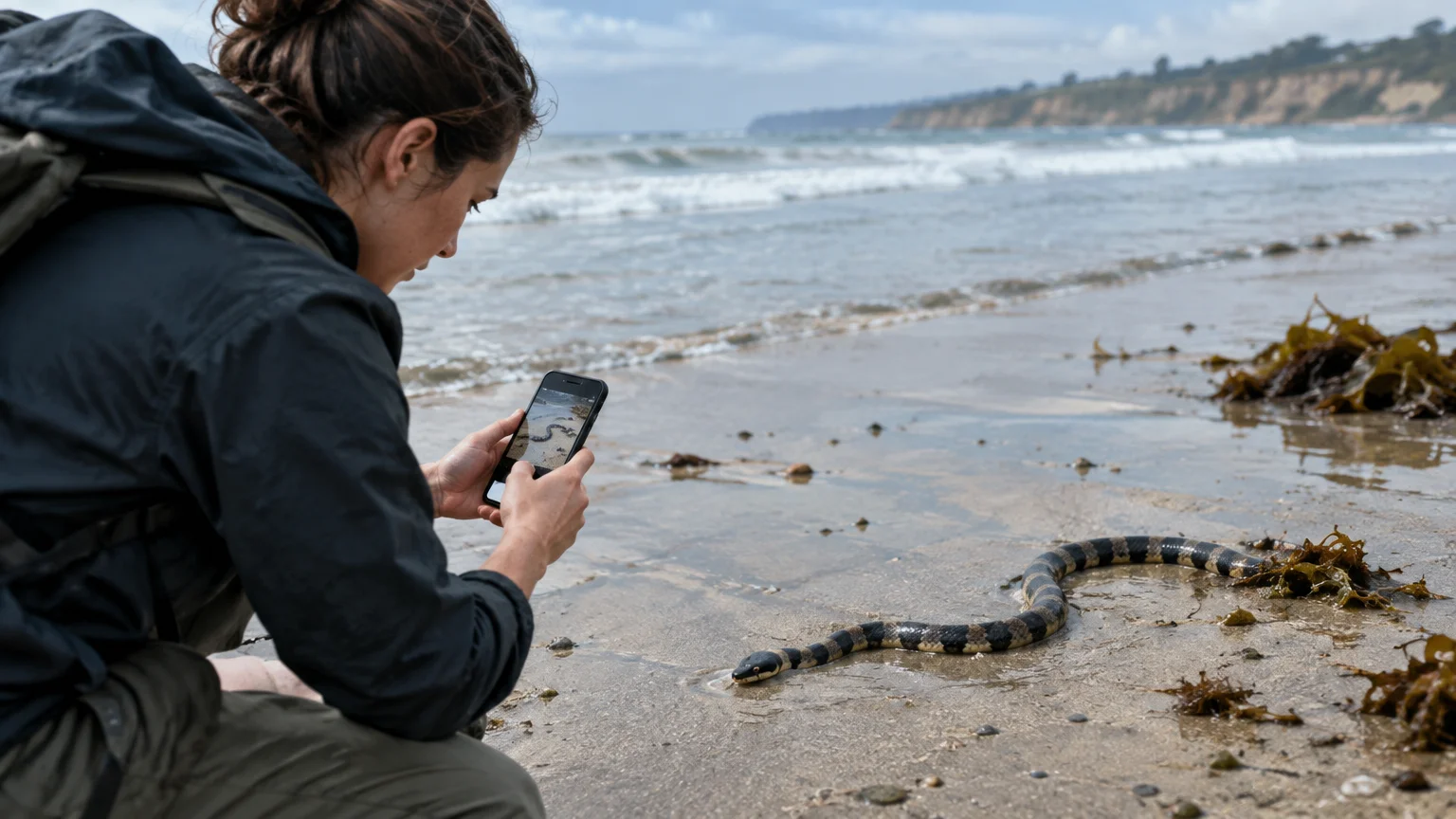
Maintain a distance of at least ten feet if you spot a black-and-yellow patterned body. Take clear photographs showing the paddle-shaped tail and note nearby landmarks or lifeguard tower numbers.
Immediately alert nearby lifeguards or park rangers so they can secure the animal safely away from the public. You should also log your photo on iNaturalist to alert local scientific repositories.
Frequently Asked Questions
How dangerous is a yellow-bellied sea snake encounter?
A sea snake encounter carries minimal risk if you do not touch the animal. They do not lunge or chase humans, and zero fatalities exist on record across California and Australia.
However, you should treat every specimen as potentially hazardous because their neurotoxic venom remains potent even after death. Standard antivenom neutralizes this venom effectively when administered promptly at a hospital.
Why shouldn’t you push a stranded sea snake back into the ocean?
Pushing a stranded sea snake back into California waters subjects an already hypothermic reptile to lethal cold shock. The water is far too cold for its muscles to function properly.
A stranded snake cannot swim against incoming breakers and will quickly exhaust its remaining energy. Alerting wildlife authorities ensures the specimen receives professional evaluation or serves important scientific research.
How often do sea snakes wash up on California beaches?
Strandings remain exceptionally rare events along the California coast. Researchers have confirmed only eight individuals since 1972, with seven appearing during powerful El Niño warming events.
Every single recorded arrival has occurred between October and January. Unless a strong ocean warming anomaly develops, you will almost certainly never encounter one on the beach.
What other tropical marine species visit California during El Niño?
Unusual warming patterns also bring tropical fish, pelagic red crabs, and rare sea turtles into coastal California waters. In 2026, researchers documented the state’s first four olive ridley sea turtle nesting sites.
These marine turtles nested across Orange, Ventura, and Santa Barbara beaches during the height of the warm anomaly. Biologists relocated more than 200 eggs to public aquariums to ensure successful incubation.
Curiosity Close: Expanding Coastal Awareness
The appearance of a tropical serpent on a Southern California beach highlights how dynamic and interconnected world oceans truly are. A single warming anomaly in the central Pacific reshapes marine ecosystems across thousands of miles.
When you walk the shoreline this winter, keep your eyes focused on the high-water line. You might witness a once-in-a-decade glimpse of deep-ocean biology written directly into the California sand.
Share this knowledge with fellow beach lovers to promote shoreline safety and marine science. By staying curious and observant, your coastal stroll might document the next major ocean discovery.