
Earth quietly captured a six-foot-wide celestial visitor in 2026, granting our planet a temporary companion known as asteroid 2026 QQ8. This tiny space rock loops through our cosmic neighborhood on a bizarre, lingering trajectory.
Remarkably, its sweeping path closely resembles a theoretical flight plan first sketched on paper in 1878 by American mathematician George William Hill.
While this new mini-moon poses no threat to your safety, its discovery validates a 148-year-old mathematical puzzle. It reveals how gravity crafts temporary celestial choreography right above your head.
In This Briefing07 Sections ▾
- 01A Cosmic Stowaway in Earth’s Gravity
- 02The 1878 Mathematics of Maximum Lunation
- 03Mini-Moon or Fleeting Flyby?
- 04Boulder, Booster, or Lunar Shrapnel?
- 05Everyday Impact: What This Celestial Visitor Means for You
- 06Frequently Asked Questions About Asteroid 2026 QQ8
- 07Curiosity Close: Expanding Your Cosmic Perspective
A Cosmic Stowaway in Earth’s Gravity
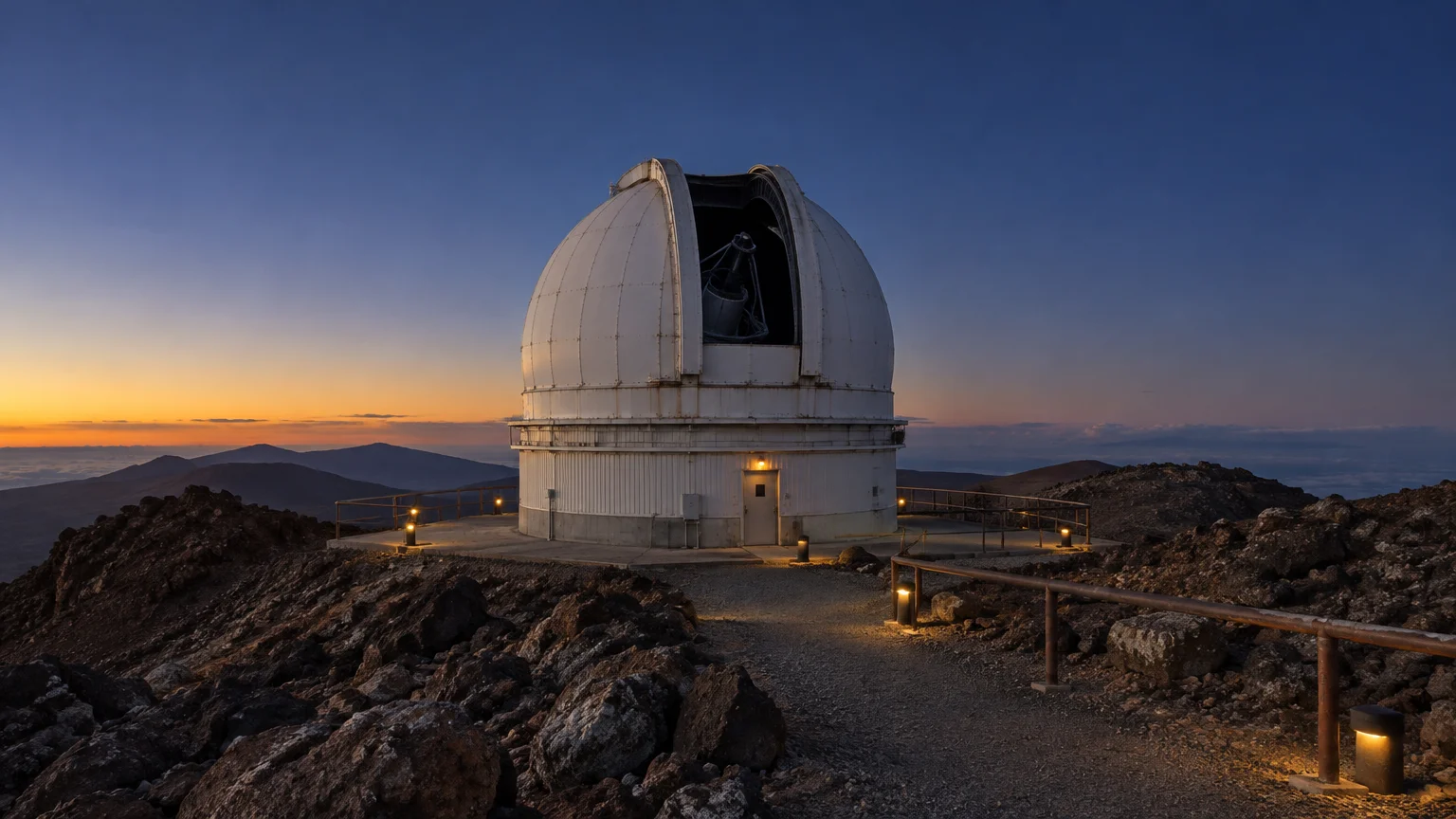
Astronomer Krisztián Sárneczky first detected the faint object on August 19, 2026, using the 0.60-meter Schmidt telescope at Konkoly Observatory’s Piszkéstető Station. Observers originally logged the mysterious pinpoint under the temporary designation Sar2901.
Initial orbital calculations immediately caused confusion among planetary researchers. Because its Earth-centered motion mimicked orbital space debris, the International Astronomical Union’s Minor Planet Center withheld the object from public confirmation pages on September 2, 2026.
Spent rocket boosters from past lunar and planetary missions frequently drift through near-Earth space. These human-made metal hulls mimic small asteroids, confusing automated tracking algorithms.
To determine the object’s true nature, astronomers scheduled follow-up tracking with the Lowell Discovery Telescope in Arizona on September 5 and 19. These critical observations extended the known orbital arc.
Astronomer David J. Tholen then observed the visitor with the University of Hawaiʻi 2.24-meter telescope on Maunakea on October 9. This data enabled scientists to measure how sunlight physically pushes against the object.
Light exerts a tiny mechanical force called solar radiation pressure. Lightweight, hollow rocket boosters accelerate noticeably under this solar push, while dense, solid asteroids barely react.
These sensitive measurements eliminated any lingering suspicion that the object was a forgotten satellite or Apollo-era rocket stage.
On October 29, 2026, the Minor Planet Center published circular MPEC 2026-U95, assigning the formal designation 2026 QQ8. The announcement confirmed the object as a natural, temporarily captured body.
The 1878 Mathematics of Maximum Lunation
When dynamicists modeled the trajectory of 2026 QQ8, they uncovered an unexpected historical connection. The asteroid’s journey matched an orbital pattern theorized almost a century and a half ago.
In 1878, American mathematician George William Hill published Researches in the Lunar Theory (III) in the American Journal of Mathematics. Hill investigated the complex gravitational interactions of the three-body problem.
Hill calculated theoretical limits for stable orbits and identified a unique class of trajectories he called a “Moon of maximum lunation.” In this configuration, an object achieves an unusually elongated, lingering orbit.
Some reports claimed an 1878 formula predicted 2026 QQ8’s exact orbit, but that overstates the historical reality. Hill did not predict this specific asteroid, but rather defined the mathematical family governing its path.
In late 2026, dynamicist Grigori Fedorets and his colleagues demonstrated that 2026 QQ8’s path closely resembles Hill’s proposed maximum lunation orbit. This represents the first observational example of Hill’s theoretical geometry in astronomical history.
When viewed in a Sun-Earth co-rotating coordinate frame, the asteroid executes a striking visual maneuver. It nearly stalls in space for up to three months near Earth’s orbital quadratures.
These quadratures lie ninety degrees away from the Sun-Earth line. At these specific positions, solar and terrestrial gravity temporarily balance, holding the tiny rock in a suspended drift.
Understanding this equilibrium helps dynamicists predict how long temporary objects can remain caught before breaking away into independent orbits around the Sun.
Mini-Moon or Fleeting Flyby?
The announcement of 2026 QQ8 sparked intense discussion regarding whether the object truly counts as a mini-moon. The answer depends entirely on which scientific metric you apply.
Planetary scientists distinguish between temporarily captured orbiters and temporarily captured flybys. Orbiters complete at least one full revolution around Earth while bound, whereas flybys make an incomplete gravitational loop.
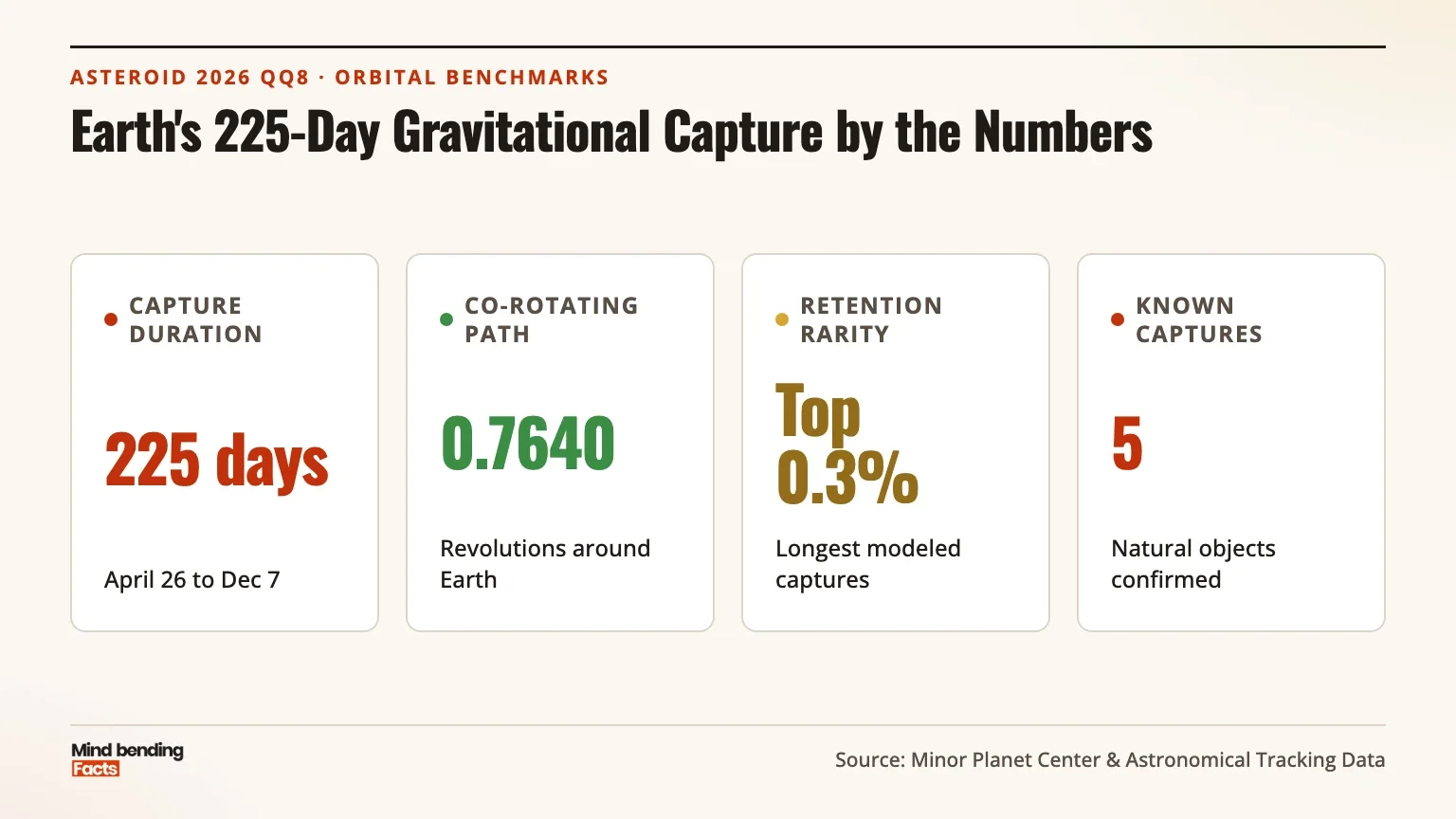
Fedorets and his team determined that 2026 QQ8 completed 0.7640 revolutions in a Sun-Earth co-rotating longitude frame. Under this standard longitude-based convention, the object strictly qualifies as a temporarily captured flyby.
Conversely, a study led by Bryce Bolin applied a three-dimensional path-curvature criterion. Under Bolin’s framework, the object completed 1.3292 turns, meeting the technical threshold for a captured orbiter.
Both research groups agree that Earth gravitationally bound 2026 QQ8 inside its Hill sphere on April 26, 2026. Orbital projections indicate the asteroid will escape Earth’s capture on December 7, 2026.
This 225-day stay spans approximately seven and a half months. That prolonged duration places 2026 QQ8 among the longest 0.3 percent of all modeled temporary captures.
This exceptionally long retention provides astronomers with an unprecedented window to observe temporary three-body capture physics in real time.
Prior flybys like asteroids 2022 NX1 and 2024 PT5 stayed bound for only about one month each. Only five natural temporarily captured objects have ever been confirmed in Earth’s history.
Boulder, Booster, or Lunar Shrapnel?
Determining the physical size of 2026 QQ8 required high-precision photometric observations from major facilities worldwide. The asteroid carries an absolute magnitude of H = 31.3, indicating a very small body.
Initial standard estimates from the Minor Planet Center suggested a width of approximately two meters, or six feet. Detailed light-curve measurements soon refined that dimension.
Fedorets and his team gathered photometric data at the Nordic Optical Telescope, finding an area-to-mass ratio of 0.5 ± 0.19 square meters per metric ton. Their results point to an S-type silicate asteroid measuring 1.3 to 1.9 meters across.
Bolin’s team utilized instruments at the Very Large Telescope, Keck, and Gemini North between November 7 and 21, 2026. They measured an area-to-mass ratio of (7.94 ± 3.41) × 10⁻⁴ square meters per kilogram.
Bolin’s spectral analysis indicated that if 2026 QQ8 is an Sq-type asteroid, it measures roughly 1.44 to 1.62 meters in diameter. However, its reflectance colors also closely align with Apollo 17 lunar basalt samples.
If the object represents lunar ejecta blasted into space by a past impact, its lower reflectivity implies a diameter between 2.26 and 2.80 meters. Either way, this Aten-class object completes a solar orbit every 359 days.
Everyday Impact: What This Celestial Visitor Means for You
You can rest assured that 2026 QQ8 poses zero impact threat to your home or safety. During its capture, its closest approach remains between 537,000 and 568,000 kilometers away, about 1.4 to 1.5 lunar distances.
Even if an asteroid this small entered Earth’s atmosphere, its two-meter frame would burn up completely at high altitude. You would witness an impressive meteor display rather than any ground damage.
Instead of presenting danger, mini-moons offer practical benefits for planetary exploration. Because their orbits closely match Earth’s velocity, visiting a captured mini-moon requires very little propulsion compared to deep-space missions.
These temporary companions provide accessible testing grounds for space agencies developing asteroid-mining technologies and planetary defense strategies. Harvesting water or metals from captured rocks could support future lunar habitats.
You can follow close-approach data directly through NASA’s Center for Near Earth Object Studies. Their database lets you monitor when near-Earth objects make scheduled sweeps past our planet.
Asteroid 2026 QQ8 passes near Earth roughly once every decade, having flown past in 1965 with another close approach projected for 2058. Staying informed empowers you to track our evolving planetary neighborhood.
Frequently Asked Questions About Asteroid 2026 QQ8
Can you observe asteroid 2026 QQ8 with a backyard telescope?
You cannot see 2026 QQ8 using amateur telescopes or standard consumer equipment. At magnitude 31.3, the object is millions of times fainter than what standard stargazing gear can detect.
Astronomers require multi-meter research telescopes, such as Gemini North or Keck, to capture its subtle reflection. These professional observatories gather enough photons to distinguish the tiny rock from background noise.
How did astronomers confirm 2026 QQ8 is not artificial space junk?
Researchers monitored how solar radiation pressure altered the object’s path. Hollow rocket boosters have high area-to-mass ratios that cause significant drift, while dense natural rocks resist that gentle push.
Tracking data from multiple observatories proved that 2026 QQ8’s acceleration matches solid silicate rock rather than thin sheet metal. This confirmation allowed the Minor Planet Center to certify it as a natural body.
When will Earth capture another mini-moon?
Earth temporarily captures small asteroids on a regular basis, though most stay bound for only a few weeks. Modern computational models indicate that temporary captures occur continuously across decades.
As next-generation sky surveys enter operation, astronomers will detect these diminutive visitors far more frequently. You can expect announcements of new mini-moons every couple of years.
Will asteroid 2026 QQ8 ever collide with Earth?
Orbital integrations confirm that 2026 QQ8 will safely escape Earth’s gravity on December 7, 2026. Its path keeps it hundreds of thousands of kilometers clear of our atmosphere.
When it returns for its scheduled flyby in 2058, it will pass safely at a distance without capture. Even on a collision path, a boulder this small would vaporize into dust.
Curiosity Close: Expanding Your Cosmic Perspective
The peculiar path of asteroid 2026 QQ8 reminds us of the predictive strength of orbital mechanics. George William Hill laid the mathematical groundwork in 1878, long before modern telescopes could detect a two-meter visitor.
Our planet does not travel through space alone; it constantly shares its orbit with dynamic, temporary neighbors. These fleeting interactions illustrate how gravitational forces quietly shape our cosmic environment every day.
You can stay engaged with current discoveries by reading preprints on the arXiv preprint server. Share this remarkable story with your fellow stargazers, and keep your eyes on the ever-changing sky.