
You carry a three-pound universe inside your skull. This dense architecture of tissue orchestrates every heartbeat, breath, and profound thought you experience. While scientists have spent centuries mapping its intricate folds, modern neuroscience continuously uncovers revelations that challenge our fundamental understanding of cognitive health. Prepare to dismantle your assumptions; the mechanisms driving your mind are far more dynamic, fragile, and resilient than you might realize.

The Astonishing Reality of Your Mind
We often treat our cognitive command center like a sealed black box, assuming it functions on autopilot until something goes wrong. However, your daily choices directly physically alter its structure. Exploring the biological truths behind your gray matter provides a critical roadmap for protecting your mental acuity.
Fact 1: You Possess 86 Billion Neurons
For decades, textbooks claimed humans had 100 billion neurons. Researchers eventually developed a precise method to dissolve cell membranes and count the remaining nuclei, revealing the true number is closer to 86 billion. This massive network forms trillions of synaptic connections, creating a unique neural fingerprint that dictates your personality and memories.
Fact 2: Your Mind Generates Enough Electricity to Power a Lightbulb
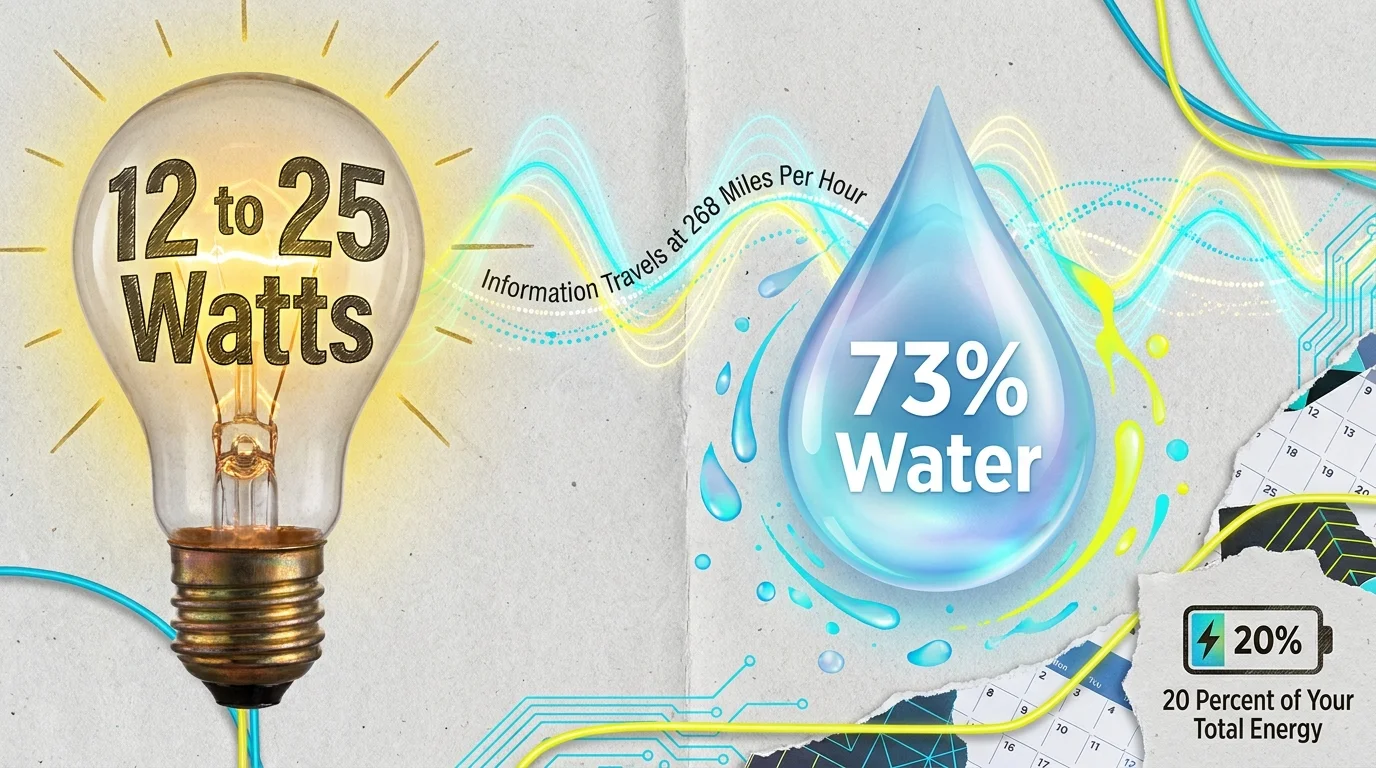
When you are awake, your brain produces around 12 to 25 watts of electrical power. This constant firing of action potentials allows vast neural networks to communicate instantly. Your cognitive engine generates enough energy to illuminate a small LED bulb, demonstrating the immense metabolic power required simply to stay conscious.
Fact 3: Information Travels at 268 Miles Per Hour
Sensory signals do not dawdle. When you touch a hot stove, the pain impulse rockets through your nervous system at speeds reaching 268 miles per hour. Specialized insulating layers called myelin sheaths wrap around your nerve fibers; these sheaths dramatically accelerate signal transmission and protect the integrity of the message.
Fact 4: The Brain Itself Cannot Feel Pain
Despite interpreting every ache and injury your body sustains, the brain contains absolutely no nociceptors—the sensory receptors responsible for feeling pain. Neurosurgeons frequently perform complex operations on fully awake patients. When you experience a headache, you actually feel the pain radiating from the surrounding meninges, muscles, and blood vessels.
Fact 5: It Consumes 20 Percent of Your Total Energy
Though it accounts for merely two percent of your body weight, your brain is a relentless energy hog. It monopolizes roughly 20 percent of your oxygen and caloric intake. Every complex problem you solve and every memory you recall requires significant glucose metabolism to sustain optimal cellular function.
Fact 6: Even Mild Dehydration Plummets Cognitive Performance
Your brain consists of approximately 73 percent water. Dropping your hydration levels by just two percent severely impairs your attention, memory, and motor coordination. Fluid loss shrinks brain tissue away from the skull, triggering localized inflammation and cognitive fatigue.
Fact 7: You Store Up to 2.5 Million Gigabytes of Data
Neuroscientists estimate your memory capacity reaches roughly 2.5 petabytes. If your brain functioned like a digital video recorder, you would need to leave the television running continuously for three million hours to exhaust its storage space. The brain efficiently compresses and links data, ensuring you rarely run out of room for new memories.
Fact 8: Neuroplasticity Lets You Rewire Your Mind
Your neural pathways are not set in stone after childhood. Neuroplasticity allows your brain to physically restructure itself in response to new experiences, injuries, and learning. When you practice a new skill repeatedly, you thicken the specific cortical areas dedicated to that task.
Fact 9: Sleep Actively Power-Washes Your Neural Tissue
Sleep serves as a highly active maintenance cycle. During deep sleep, your brain cells physically shrink to allow cerebrospinal fluid to rush through the tissue. This mechanism—known as the glymphatic system—flushes out toxic proteins linked to neurodegenerative diseases.
Fact 10: Chronic Stress Literally Shrinks Your Brain
Elevated cortisol levels from chronic stress wreak havoc on your neural architecture. Prolonged exposure to stress hormones directly damages the hippocampus, the region responsible for memory and emotional regulation. Consequently, managing stress becomes a biological necessity rather than just a psychological comfort.
Fact 11: Your Gut Bacteria Dictate Your Mood
A massive network called the vagus nerve directly connects your digestive tract to your brain. Your gut microbiome produces around 90 percent of your body’s serotonin. Therefore, the bacterial diversity in your stomach profoundly influences your emotional stability and cognitive clarity.
Fact 12: Visual Processing Dominates Your Cortex
Your brain prioritizes sight above all other senses. Approximately 30 percent of your cerebral cortex dedicates itself to processing visual information, compared to just eight percent for touch and three percent for hearing. Your visual system demands enormous processing power to interpret depth, color, and motion simultaneously.
Fact 13: Bilingualism Delays Cognitive Decline
Learning and regularly speaking a second language forces your brain to build robust cognitive reserves. Clinical evidence shows that bilingual adults typically delay the onset of dementia and Alzheimer’s disease by an average of four to five years compared to monolingual speakers.
Fact 14: Your Brain Matures in Your Mid-Twenties
You may legally become an adult at 18, but your neurological development continues for nearly another decade. The prefrontal cortex—the region governing impulse control, risk assessment, and long-term planning—does not fully wire itself until around age 25.
Fact 15: The 10 Percent Myth is Entirely False
Pop culture loves to claim humans only use 10 percent of their brains. In reality, brain imaging scans prove you use 100 percent of your brain throughout the day. Even while you sleep, every region maintains baseline activity to sustain your vital functions.

Research Breakdown: How We Uncovered These Neurological Marvels
To move beyond mere trivia, we must examine the rigorous scientific methods that brought these facts to light. The discovery of the glymphatic system provides a perfect example of modern neuroscientific ingenuity. Researchers traditionally struggled to understand why sleep deprivation correlated so strongly with rapid cognitive decline and Alzheimer’s disease. The brain lacks a traditional lymphatic system to clear out cellular waste; therefore, scientists needed a new mechanism to explain neural detoxification.
In a groundbreaking study published in the journal Nature, researchers utilized two-photon laser scanning microscopy to monitor the brains of living mice. They injected fluorescent tracers into the cerebrospinal fluid and observed the animals as they transitioned from wakefulness to sleep. The results were spectacular. The researchers witnessed the interstitial space between brain cells expand by 60 percent during sleep. This structural shift allowed cerebrospinal fluid to aggressively flush through the tissue, sweeping away beta-amyloid proteins—the very same proteins that form damaging plaques in Alzheimer’s patients.
This study established a direct, mechanical link between adequate sleep and long-term brain health. Furthermore, it demonstrated that sleep acts as a biological dishwasher for your gray matter. When you cut your rest short, you abruptly halt this cleaning cycle, allowing neurotoxins to accumulate and impair your cognitive longevity.
Daily Implications: Transforming Brain Trivia Into Action
Understanding these mechanisms offers you practical strategies to protect your cognitive health immediately. Consider the impact of hydration on your neural tissue. Since your brain requires a delicate balance of water and electrolytes to generate electrical signals, waiting until you feel severely thirsty means your cognitive performance has already degraded. Make a habit of consuming water steadily throughout the day to maintain maximum synaptic firing speed.
Your daily routines also directly dictate your brain’s physical structure through neuroplasticity. If you spend hours doomscrolling through negative news, you reinforce neural pathways associated with anxiety and stress. Conversely, engaging in complex, novel tasks—like learning an instrument, navigating a new city without GPS, or studying a foreign language—forces your brain to sprout new dendrites. You actively build cognitive reserves that protect against future decline.
Dietary choices take on new weight when you acknowledge the gut-brain axis. Every time you consume processed foods stripped of fiber, you starve the beneficial bacteria responsible for synthesizing your serotonin. Feeding your microbiome with fermented foods and diverse plant fibers represents a direct investment in your mood regulation and mental clarity.

Expert Insight: The Frontier of Preventative Neurology
Neurologists emphasize that cognitive health requires proactive maintenance. Clinical experts increasingly view neurodegenerative diseases not merely as inevitable consequences of aging, but as conditions heavily influenced by cumulative lifestyle factors. By addressing vascular health, metabolic function, and chronic inflammation early, you establish a resilient foundation for your brain.
Healthcare professionals stress the undeniable link between cardiovascular exercise and brain volume. Engaging in regular aerobic activity increases blood flow to the hippocampus, delivering the necessary oxygen and growth factors required to spawn new neurons. Guidelines from the National Institute on Aging consistently highlight that managing blood pressure and staying physically active are among the most effective, evidence-based methods for preserving cognitive function well into your later decades.
Frequently Asked Questions
Can I increase my brain’s physical storage capacity?
You cannot simply upgrade your brain’s storage like a hard drive; however, you can improve its efficiency. By practicing active recall and getting adequate sleep, you strengthen synaptic connections. This process, known as long-term potentiation, makes retrieving existing memories faster and creates denser neural networks for acquiring new information.
Is it safe to rely on cognitive enhancement supplements?
Most over-the-counter nootropics lack rigorous clinical oversight. While certain compounds like caffeine and L-theanine demonstrate mild cognitive benefits, many commercial “brain boosters” provide placebo effects mixed with heavy doses of stimulants. Relying on unregulated supplements poses risks to your cardiovascular system and can disrupt the delicate neurotransmitter balance required for healthy brain function.
How do researchers map brain activity without causing damage?
Modern neuroscience relies heavily on functional Magnetic Resonance Imaging (fMRI). This technology measures brain activity by detecting changes associated with blood flow. When an area of the brain activates, it demands more oxygen; the fMRI scanner captures this blood-oxygen-level-dependent contrast without exposing you to harmful radiation or requiring surgical intervention.
Will understanding neuroplasticity cure brain damage in the future?
While neuroplasticity allows healthy regions of the brain to compensate for damaged areas, it is not a miraculous cure-all for severe traumatic brain injuries or advanced neurodegenerative diseases. Researchers are actively exploring how to artificially stimulate targeted plasticity using transcranial magnetic stimulation and intensive physical therapy, offering significant hope for improved stroke rehabilitation.
Protecting Your Cognitive Health
Your brain demonstrates a remarkable capacity for adaptation and endurance. Every sleep cycle, every glass of water, and every new challenge you tackle physically shapes the architecture of your mind. While the statistics regarding your neural pathways and metabolic demands are astounding, they ultimately serve as a reminder of your vulnerability. Prioritizing cardiovascular health, managing chronic stress, and securing restorative sleep are not optional luxuries—they are fundamental requirements for maintaining your identity and intellect.
If you experience persistent brain fog, sudden memory lapses, or chronic sleep disturbances, do not attempt to self-diagnose using online resources. These symptoms often serve as early warning signs for underlying metabolic, vascular, or neurological conditions. Always consult a licensed primary care provider or a board-certified neurologist before beginning new supplement regimens or radically altering your lifestyle. Medical professionals provide the diagnostic tools necessary to safely interpret your symptoms and protect your irreplaceable cognitive command center.